
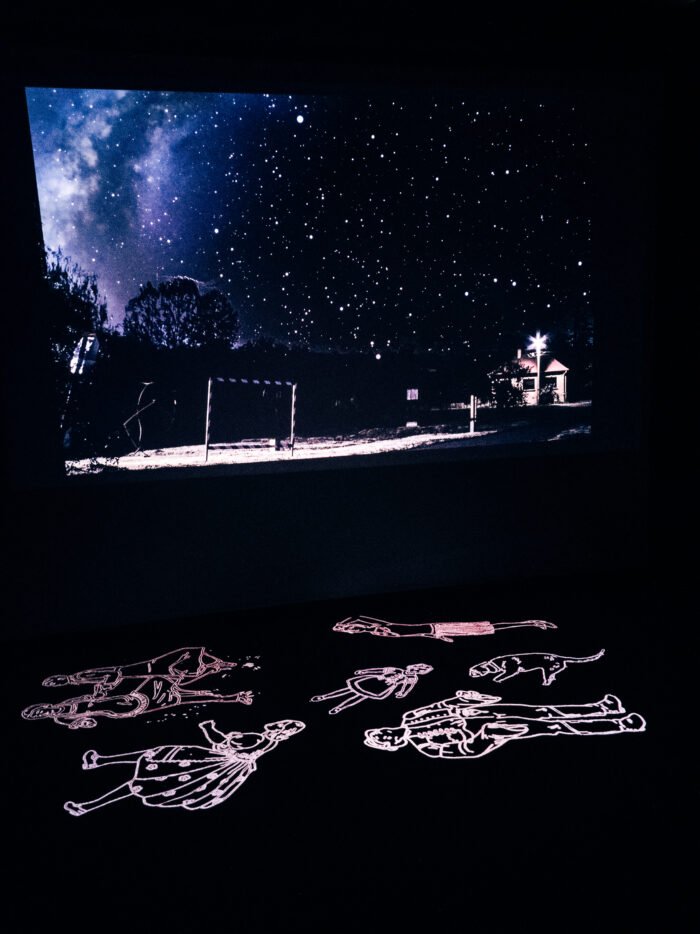
videóinstalláció
2026
When we look up at the evening sky, it appears constant and motionless. From a human perspective, the positions of the stars and constellations seem unchanged. Yet this apparent stillness is an illusion. The Earth is not a body rotating perfectly stable. Like a spinning top tilted slightly to one side, the angle of its axis of rotation slowly wobbles due to the gravitational pull of the Sun and the Moon—this is called axial precession. As a result, the Earth’s axis points in a constantly changing direction in space. The length of a full cycle, during which this axis points in the same direction again, is approximately 26,000 years.
The animation projected onto the screen in our video installation condenses this time span into a five-minute runtime. During this time, the perspective of the visitor—and of the figures resting on the wall hangings, sleeping peacefully beneath the screen—remains unchanged: they are looking precisely toward zero degrees north; only the significantly accelerated time changes as we travel from 13,000 BCE to 13,000 CE.
This video of the changing night sky is a time-lapse animation composed of 6,051 frames calculated by an astronomical software (Stellarium). By capturing the changes in the frames every four years, the video documents a process spanning nearly 26,000 years, attempting to show how the sky might have appeared from Cered ten thousand years ago, or how it will appear to the people living here 10.000 years after…
As the centuries pass, the constellations also wander across the celestial dome. The position of the Milky Way changes as well, and even the North Star is replaced by others (such as Arca Draconis or Vega) instead of its current location (Ursa Minoris, the Little Bear). Considering their four-year cycle, the shift is insignificant; over the course of 26,000 years, the world almost completely turns with us. The change is permanent and predictable, even if we believe the world to be constant and unchanging or experience it as such.
In the folk and petty-bourgeois culture of the time, wall hangings also traditionally symbolized reliability and stability, among many other aspects of life. For so long, the inhabitants of these wall hangings were forced to stand their ground and offer guidance or criticism that it is finally time for them to rest. It is time to dream.